
High-Tech Trapped
Why is our society so dangerously vulnerable to entirely predictable events?

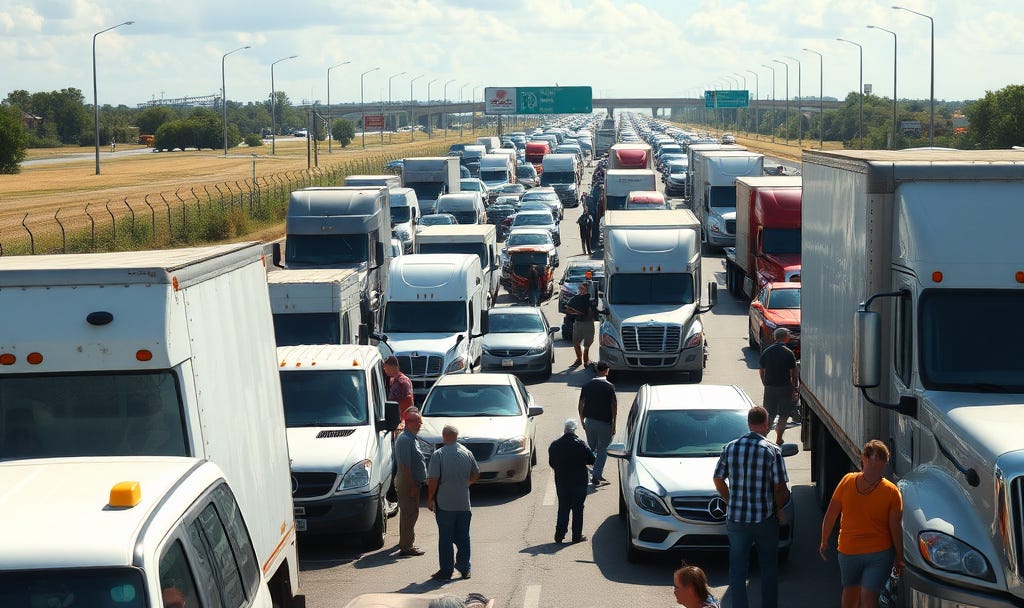
I can see the future. I’m sure you can, too. The problem is, our leaders don’t seem to be able to. Maybe they just aren’t trying hard enough.
I was recently stuck on I-95 in Florida for four hours because of a fatal truck crash. The highway became a parking lot. No detours. No shoulders cleared. Endless rows of idling cars baking in the sun.
A friend recently told me about her own nightmare on I-75 a short time after mine: it was a fatality accident that shut down the interstate for nearly eight hours in Collier County, Florida north of Naples. Eight hours!
People were hungry, tired, running low on gas, and missing critical appointments or flights. Some were trying to pull over and use the bathroom on the side of the road, with truckers stepping in to help shield them from public view with their vehicles. She says rumor had it that people were having heart attacks and other medical emergencies in their cars. Anyone who tried to maneuver around the closed lanes got turned around or ticketed. Stay put, even if it kills you.
To be sure, a single fatality is tragic and evidence must be preserved. But there’s no excuse in 2026 for turning one accident into a rolling semi-humanitarian crisis on a major interstate.
It would only take authorities simply prioritizing efficiency and general public safety to avoid these disasters. Law enforcement would treat traffic restoration as the top priority after initial documentation by a quick-response forensic team. Drones and 360-degree cameras can capture scenes in minutes. Temporary traffic shifts—opening the opposite-direction lanes, using shoulders, or creating contraflow patterns—are standard practice in other countries and even sometimes in the U.S. during construction. Why not when efficiency and public safety are on the line?
Our problems aren’t limited, of course, to a few bad days on I-75 or I-95. These incidents are symptoms of something deeper and more disturbing: we are flush with technological “advancements,” yet our society is actually an incredibly fragile system with almost no redundancy or backup plans in key areas.
One single point of failure—a crash, a storm, an attack, a software glitch, a government shutdown—and things grind to a halt. We act shocked each and every time, as if we’re starting over and reinventing the wheel (though we never actually seem to get the new invention designed) when the solutions are often embarrassingly simple.
Read on for details.
Long before 9/11, those of us who lived or worked in Washington, D.C., occasionally spoke of the inevitable day a major terrorist attack or disaster would hit. The conversation was always the same: How would we get out of the city? The roads were already a nightmare on a good day. A real crisis would turn every exit from D.C. into a steel trap.
An old producer at CBS News where I worked at the time used to say that when the inevitable terrorist attack came, he planned to grab a folding chair in his office, go out to the front of the building at 2020 M Street Northwest, sit in the chair, “bend over, and kiss his sweet ass goodbye,” because nobody would be able to get out of town.
On September 11, 2001, that theoretical nightmare came true. I was heading into D.C. when Islamic extremist terrorists crashed a plane into the Pentagon. Traveling along the George Washington Parkway, I saw smoke rising from the military headquarters. I knew I had a quick decision to make: try to turn around and head home, or continue to work across the bridge into Washington D.C., where I understood I’d likely be stuck.
I crossed the bridge into D.C.
Traffic didn’t just slow down—it stopped dead. The White House, Capitol, and other potential targets were in lockdown. People tried to evacuate as they heard the news, but they couldn’t get anywhere. Thousands of us had no choice but to abandon our cars in the middle of the streets. We then walked to work or some other destination.
On this day, our vulnerability was exposed with stark clarity. Yet, incredibly, it was never followed by a plan to avoid a repeat.
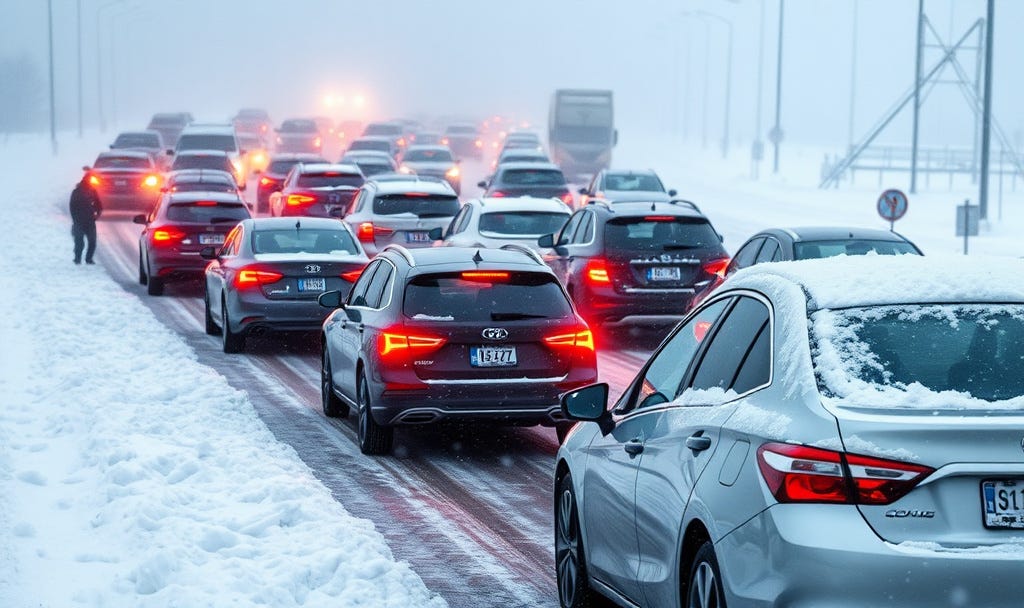
Fast-forward to February 2010—“Snowmageddon” in Washington, D.C. A massive blizzard dumped as much as two feet of snow on the region. Once again, there was a traffic standstill so serious, it risked lives. Thousands were stranded for up to 14 hours. People ended up abandoning their cars on highways and side streets.
Yet, even then, there was no effort to develop a comprehensive plan to avoid a repeat. And just a year later—there was one.
On January 26, 2011, it was “Carmageddon.” Thundersnow struck during evening rush hour, turning the commute into unusually vicious chaos, again stranding people for as long as 14 hours. I was one of them. I remember it well because it was my fiftieth birthday. For the second time during my D.C.-based career, I found myself abandoning my car in the middle of the road. I walked almost two miles in freezing, icy, slushy, darkness (wearing semi-high heels, no less) back to the city, seeking shelter. There were no buses or taxis. No plows getting through. And no police were out: they were hunkered down. People risked frostbite and hypothermia. Emergency vehicles couldn’t reach calls. And yet, after that— at least as far as we know— the backup plans for evacuating or moving people safely out of D.C. in a crisis remain… nonexistent.
Our communications are another soft spot where we seem to have no viable backup plan despite critical, obvious vulnerabilities. One glitch can bring life to a standstill in a society that is supposedly among the most technologically advanced in the world.
This was highlighted on 9/11. Cell phone networks were overwhelmed by sudden, massive call volume. People couldn’t reach loved ones. Basic communications couldn’t happen. Critical agencies couldn’t talk efficiently to one another.
All these years later, our technology has supposedly never been better, but there still seems to be no big plan in the event of crisis. Even on days without crisis, we are marred by outages and spotty communications.
Hurricanes hit with predictable regularity. Yet we have no good backup plan ready to avoid compounding natural disaster with human ones. We seem to watch the same movie. Entire regions go dark for communications. First responders can’t coordinate. Families can’t check on loved ones.
In the aftermath of Hurricane Helene in 2024, it was Elon Musk who came to the rescue, sending his Starlink satellites to restore connectivity. The government didn’t have an instant, pre-deployed backup communications plan ready to roll. Local and state officials had to beg, borrow, or wait for private innovation to fill the gap.
Beyond traffic and communications, our basic transportation at vital airports can be upended by simple and predictable political dysfunction because we have no effective backup plans in place.
When air traffic controllers, or more recently TSA agents, got cut off due to government shutdowns, it paralyzed major airports, sending our travel system into crisis. Our critical infrastructure is shockingly fragile. It’s as if we’ve learned nothing from the past.
The electric grid is another soft spot. Go back to the 2021 Texas winter storm. A cold snap, entirely foreseeable in a state with extreme weather history, crippled the power grid because the grid wasn’t winterized. Millions lost electricity and heat in freezing temperatures. Water treatment plants failed. People died. The same state that leads in oil and gas production had no robust backup plan for its own electric grid.
And then there are the supply-chain disasters. One ship stuck in the Suez Canal in 2021. The pandemic lockdown in China. A ransomware attack on a major port. Semiconductors vanish, car factories idle, grocery shelves empty of baby formula or toilet paper. Some may think of these as “black swan” events, but they’re predictable vulnerabilities that we continually fail to plan for. So they happen again and again.
The irony is brutal. We have the technical capability to land robots on Mars, sequence genomes in hours, and stream high-definition video from anywhere on Earth. We’re now heading back to the Moon. Yet we can’t figure out how to open the opposite lanes on I-75 after a crash or guarantee cell phone service after a hurricane.
These are just a few among hundreds—perhaps thousands—of examples that show how we have become a high-tech society that can be embarrassingly crippled by any number of simple, predictable events. We are victims of short sightedness and short term thinking. Lack of imagination. Solving these issues simply requires a new mindset among our leaders.
Why not convene special commissions of great thinkers on given topics? They could devise realistic, cost-effective solutions that could be put in place quickly on a variety of fronts.
To end where we began (to finish a point): there’s no excuse for the poor traffic management we have daily in most American cities, costing us incredibly in terms of lost productivity, wasted fuel, and even public safety— let alone the lack of planning for the next inevitable crisis event.
The money, time, and lives that would be saved are doubtlessly countless. If only our leaders would act upon the future that we can clearly see.
Politicians and other grifters find funneling money to pet projects and advocacy groups much more lucrative than public infrastructure.
I’m old in my sixties. Ive recently been getting rid of all my stuff that no longer serves me. Major declutter, give always, and downsizing.
One thing I did hold on to was all my dvd collection I had boxed up because I was using steaming services. I unsubscribed to all of the streaming services. Canceled my internet, and bought a DVD player.
And so I’m not totally in the dark.. I bought a HDMI to lightening cable that I can hook my iPhone to TV and mirror YouTube videos. That only cost 25 dollars a month on the Visible plan that is owned by Verizon.
I’m disconnecting slowly.
After Katrina… I saw the writing on the graffiti filled walls and moved to rural town. No stop light kind of town.
Best thing I ever did. No traffic, ever! I live on country time. No damn movie theaters or fancy restaurants. No woke nonsense.
In a way.. I’ve been preparing for a time when the SHTF. Minimalist lifestyle. I’m not hoarding for the end times. No stockpiles of crappy survival food. I can live on a flock of chickens just like my grandma did. Raise a pig or two.
I stopped flying in 2010 because of TSA, so I won’t be needing the real ID.
Katrina showed me what happens when the SHTF and it isn’t what people think..